
Your feelings are information, not instructions
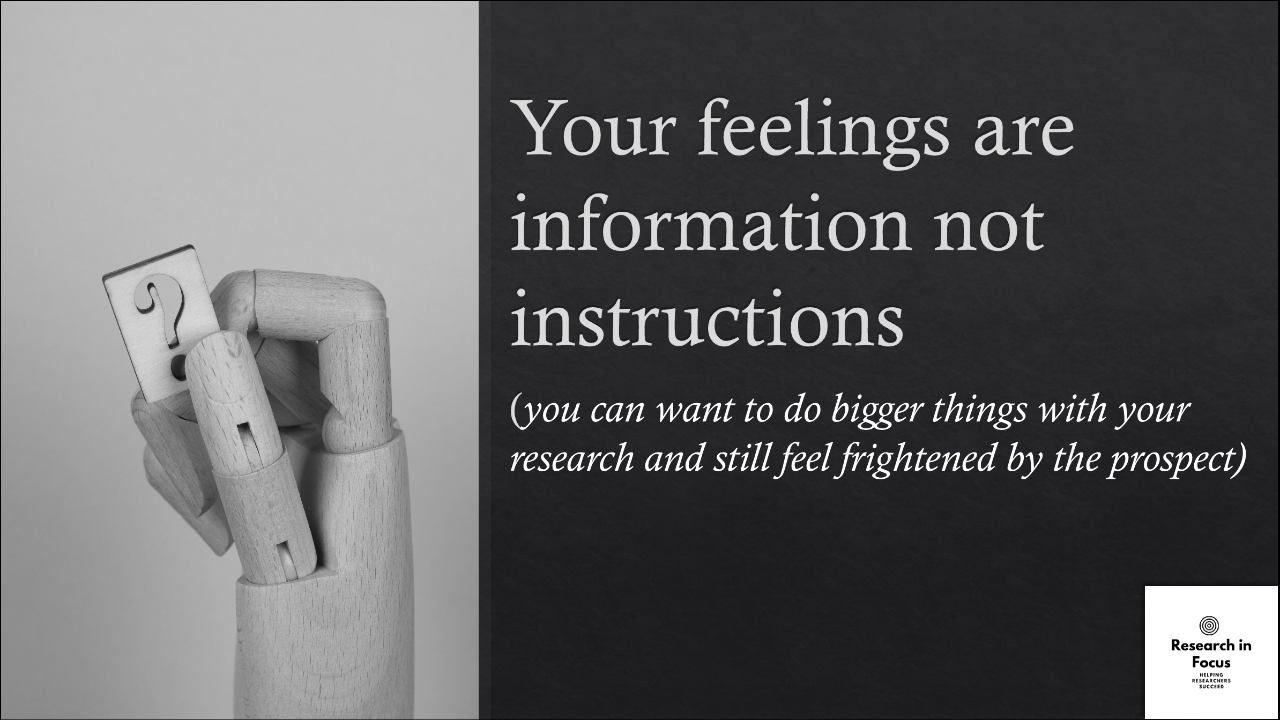
You can want to do bigger things with your research and still feel frightened by the prospect. The trick is to learn from your feelings without letting them decide what you do next.
Perhaps you have an idea for a research programme that could make a genuine difference to your field. You can see the potential for a substantial grant, a collaboration that brings together people who have never worked together before, or a body of work that could influence policy, practice or the way we understand the world.
You can imagine what might be possible. For a moment, the idea feels exciting.
Then the doubts arrive.
Who am I to lead something on that scale? What if the idea isn't sufficiently original? What if I spend months developing a proposal and it gets rejected? Surely I need to do more preliminary work before I approach potential collaborators. Perhaps I should wait until I have a little more time, a little more experience, or a little more certainty.
Before you know it, the idea has been quietly returned to the back of your mind. You have done some useful work, answered some urgent emails and helped several colleagues. You feel productive, but the research agenda you wanted to develop remains untouched.
If this sounds familiar, it may be tempting to conclude that you lack confidence.
But what if confidence isn't the real problem? What if your feelings are giving you information about the challenge you are contemplating, rather than telling you what you should or shouldn't do?
Your feelings are information, not instructions. Learning to distinguish between the two can help you pursue a more ambitious research agenda without waiting to feel ready.
Why bigger ambitions can bring uncomfortable feelings
When we contemplate doing something that matters to us, particularly something that stretches our current sense of what is possible, we are not simply evaluating the practical merits of the opportunity. We are also responding to uncertainty, potential loss, social expectations and the possibility of being judged.
A larger research grant, for example, might offer the resources to pursue a question you have wanted to investigate for years. It might also mean greater visibility, more responsibility, a higher chance of public rejection and the possibility of discovering that you cannot control every aspect of a complex project.
It makes sense that such an opportunity could produce excitement and apprehension at the same time.
Psychologists have long studied the ways in which people respond to uncertainty and perceived threat. Research on the behavioural inhibition system, for example, explores how sensitivity to potential punishment or adverse outcomes can encourage caution and avoidance (Gray, 1982; Gray and McNaughton, 2000). Avoiding a challenging opportunity can provide immediate relief from anxiety, even when it takes us further away from a longer-term goal.
This is one reason why waiting until you feel confident can become a trap. If you repeatedly avoid situations that make you uncomfortable, you may never gather the experience that would help you feel more capable of handling them.
Imagine that you are considering developing a proposal for a substantial grant. You feel anxious about whether your idea is good enough, so you decide to read more literature before discussing it with anyone. Reading feels safe and productive. You tell yourself that you will approach a potential collaborator once the idea is more developed.
But the more you read, the more gaps you discover. Your idea becomes more complicated, and the moment when you feel ready to share it moves further away.
The problem is not that reading is unhelpful. It is that you may be using it to manage your feelings rather than to advance your research.
Your anxiety contains useful information: this opportunity matters to you, the outcome is uncertain, and you may need to strengthen your idea or seek some support. It does not necessarily follow that you should postpone action.
What your feelings might be telling you
Feelings are not random inconveniences to be eliminated before we can think clearly. They can help us notice what matters, where we perceive risk and what might need our attention.
However, feelings are not infallible assessments of reality. Anxiety can alert us to a genuine risk, but it can also exaggerate the likelihood or consequences of failure. Excitement can signal an opportunity worth exploring, but it does not guarantee that an idea is viable. The useful question is not simply, "How do I stop feeling this way?" It is, "What can I learn from this feeling, and what would be a constructive response?"
Consider some common experiences that arise when you start thinking bigger about your research.
"I'm frightened that my idea isn't good enough."
This might tell you that the idea needs further development, that you need feedback from someone with relevant expertise, or that you are contemplating a more ambitious intellectual contribution than you have made before. It does not establish that the idea is poor. Nor does it mean you must resolve every uncertainty before sharing it.
A useful response might be to write a one-page outline of the research problem, the contribution you want to make and the difference the work could create. Then ask a trusted colleague to challenge your thinking.
"I don't feel qualified to lead something this big."
This might reflect a genuine gap in your experience, a need to build a team with complementary expertise, or uncertainty about the responsibilities involved. It might also reflect the fact that you have become accustomed to seeing yourself as a capable contributor rather than as the person who sets the direction.
Instead of treating the feeling as a verdict on your suitability, identify the specific capabilities the opportunity requires. Which do you already possess? Which could you develop? Where would collaboration help?
You may discover that you are better equipped than you thought, or that you need a particular kind of support. Either way, you have something concrete to work with.
"I can't justify spending time on this when so many other people need me."
This feeling may be pointing towards a real capacity problem. You may genuinely have too much work, insufficient support or caring responsibilities that limit the time available to you. It may also reveal an assumption that your own ambitions should come after everyone else's needs.
The answer is not to dismiss the feeling or pretend that you have unlimited capacity. It is to examine your commitments and make a deliberate decision about where your time and expertise will have the greatest value.
If your research could make a significant contribution, protecting time to develop it is not necessarily selfish. It may be part of taking your responsibilities as a researcher and leader seriously.
"What if I put myself forward and fail?"
This is a particularly understandable concern in academia, where grant applications and promotion decisions are competitive and rejection is commonplace. The feeling may be reminding you that the outcome matters and that the investment of time and energy is real. But it cannot tell you, in advance, whether a proposal will succeed. Nor can it determine whether the process will be worthwhile.
You might not secure the grant. You could still develop a stronger research agenda, establish valuable collaborations, clarify your intellectual contribution and learn what funders need to see. Those benefits do not make rejection painless, but they can make the effort worthwhile.
The aim is not to convince yourself that everything will work out. It is to make decisions that remain sensible even when the outcome is uncertain.
Why women academics may find this particularly challenging
For women in academia, there can be additional reasons to pay attention to the relationship between feelings, perceived risk and professional action. Women do not all experience their careers in the same way, and hesitation is certainly not exclusive to women. Nevertheless, research on gender and organisational behaviour has identified patterns that can make professional visibility, self-promotion and ambition more complicated for women in some contexts.
For example, research by Heilman and colleagues has examined the ways in which women may encounter negative evaluations when their behaviour conflicts with expectations about how women should behave (Heilman and Okimoto, 2007). Work by Moss-Racusin and colleagues (2012) also demonstrated how gender bias can affect assessments of scientific competence in an experimental academic hiring context.
These studies do not establish that every woman faces the same barriers, or that every instance of self-doubt has its origins in discrimination. They do, however, help explain why concerns about being judged, appearing overconfident or making a visible mistake may not be entirely imaginary.
Women may also have learned, through experience or social expectations, that being helpful, agreeable, reliable and responsive is a valued way to operate. These qualities can make an enormous contribution to research teams and academic communities. The difficulty arises when maintaining that role becomes more important than pursuing one's own intellectual ambitions.
You may find it easier to respond to a colleague's request than to protect an afternoon for your own grant development. You may be comfortable describing the contribution of a collaborative team but uncomfortable making a strong claim for the originality of your own work. You may feel that you should have a fully developed proposal before inviting someone to discuss an idea. These behaviours can be entirely understandable. They may even have helped you succeed so far.
But a strategy that works well for establishing yourself as a dependable colleague may not be sufficient for becoming the research leader you want to be. The point is not to stop caring about others, abandon collaboration or become someone you are not. It is to recognise when your desire to remain safe, acceptable or indispensable is influencing your choices more than your aspirations are.
Your feelings can help you notice that tension. They do not have to settle it on your behalf.
You don't need to feel confident to take the next step
One of the most persistent myths about confidence is that it must precede action. We imagine that successful researchers have a clear vision, believe wholeheartedly in their abilities and feel ready to take on the challenge. In reality, confidence is often uneven. You may feel highly capable in your own area of expertise while feeling uncertain about leading a large interdisciplinary programme, asking a senior colleague to collaborate or making a bold claim about the significance of your research. Confidence is not a single, stable quality that you either possess or lack. It can vary by situation and develop through experience.
Albert Bandura's work on self-efficacy — people's beliefs about their ability to organise and carry out the actions required to achieve a particular outcome — highlights the importance of mastery experiences: learning from doing something and discovering what you can manage (Bandura, 1997).
This has a practical implication. Rather than waiting for confidence to appear, you can take manageable actions that help you build evidence of your own capability. You do not need to feel ready to sketch an ambitious research question. You need to be willing to sketch it. You do not need to be certain that a potential collaborator will be interested. You need to be willing to start a conversation. You do not need to know whether a grant application will succeed. You need to decide whether developing the proposal is a worthwhile investment, and you do not need to be confident that you will become the research leader you imagine. You need to take the next step towards finding out what is possible.
This is not about forcing yourself through every uncomfortable feeling. Some feelings signal that you need more information, better support, additional skills or a different approach. The objective is to respond thoughtfully, rather than automatically obeying the urge to withdraw.
A practical way to work with your feelings
The next time you notice yourself hesitating over a research idea or professional opportunity, try separating three things: what you feel, what you think that feeling means, and what you choose to do.
- Name the feeling.
Be specific. Are you anxious about rejection? Embarrassed by the thought of making an ambitious claim? Frustrated by the amount of work involved? Guilty about taking time away from other responsibilities?
Simply identifying an emotion can help you examine it rather than treating it as an unquestionable truth.
- Ask what information it might contain.
What is the feeling drawing your attention towards? Is there a genuine practical risk to address? Do you need advice, additional resources, a clearer plan or a conversation with someone who understands the funding landscape?
Or might you be reacting to uncertainty, unfamiliarity or the possibility of being judged?
More than one explanation may be true.
- Separate the evidence from the prediction.
"I feel frightened that my proposal will be rejected" is an observation about your present experience and a possible future outcome.
"My proposal will be rejected" is a prediction.
"I don't yet know how to lead a project of this scale" may identify a genuine development need.
"I'm not the sort of person who can lead a project of this scale" turns that development need into a fixed judgement about your identity.
These distinctions matter because they create room for alternative interpretations and responses.
- Choose an action that serves your ambition.
Once you have considered the information, ask what would move your research forward.
Perhaps you need to explore a funding call, speak to a research development manager, write a rough concept note, test your thinking with a colleague or block out time to develop the research question.
Choose something specific enough to complete, but meaningful enough to create movement.
- Review what you learn.
After taking action, consider what actually happened. Did you receive useful feedback? Did the task prove more manageable than expected? Did you discover a genuine obstacle? What would you do differently next time?
This is how you turn experience into evidence. You are not trying to prove that you should never feel anxious. You are learning that anxiety can be present without having the final say.
Be brilliant, but allow yourself to be imperfect
There is a particular kind of perfectionism that can be difficult to recognise in high-achieving research leaders. It does not necessarily involve producing poor work or missing deadlines. It can look like conscientiousness, intellectual rigour and a desire to get things right. Those qualities are valuable. But they can also become a reason to delay the activities that would help you grow.
You might keep refining a research idea before testing it with anyone. You might tell yourself that you will approach a major funder once you have published another paper. You might wait until your workload is under control before thinking seriously about your longer-term research direction. The difficulty is that there will always be more literature to read, more work to complete and more reasons to postpone something uncertain. Being brilliant does not require you to be certain. Nor does it require every early attempt to be polished.
You can develop a thoughtful research agenda while still having questions about it. You can make a credible approach to a potential collaborator without knowing whether they will say yes. You can submit a carefully prepared proposal without being able to guarantee success.
Indeed, allowing yourself to work imperfectly at the early stages may help you reach a better outcome. Sharing an emerging idea can reveal weaknesses while there is still time to address them. Testing an assumption can prevent months of work in the wrong direction. Seeking feedback before you feel entirely ready can bring expertise and perspectives into the process sooner.
The important distinction is between being imperfect in how you proceed and being careless about the quality of your work. You can retain high standards while accepting that progress involves uncertainty, experimentation and revision.
And you can take your ambitions seriously without treating every setback as a judgement on your worth.
Your feelings may tell you that you are entering unfamiliar territory. They may remind you that the stakes are high, that you need support or that you are stretching beyond your established expertise.
Listen to that information.
Then decide what to do with it.
The research contribution you most want to make may require you to do things that feel uncomfortable before they feel natural. You may need to become more visible, make stronger claims about the significance of your work, ask for resources or take the lead on an idea that is not yet fully formed.
You can do all of that while feeling uncertain.
You do not have to wait until fear disappears. You do not have to manufacture confidence you do not yet possess. You simply need to stop treating the absence of confidence as proof that you should not proceed.
Your feelings deserve your attention. Your ambitions deserve it, too.
Five ways to move forward — brilliantly and imperfectly
- Write down the ambition before you talk yourself out of it.
Give yourself 15 minutes to describe the research contribution you would most like to make over the next five to ten years. Do not begin by asking whether it is realistic, fundable or compatible with your current workload. Start with what you would genuinely like to contribute. You can assess the practicalities afterwards.
- Turn one uncomfortable feeling into a useful question.
When you notice yourself hesitating, write down the feeling and ask what information it might contain. If you are worried that your grant idea is not good enough, identify what you need to test or learn. If you are frightened of being judged, consider whose feedback would be useful. Do not let a feeling become a verdict without examining the evidence.
- Take one small, visible action before you feel ready.
Draft a one-page concept note. Email a potential collaborator. Arrange a conversation with your research development team. Book an hour to explore a funding opportunity. Choose an action that moves the idea beyond your head and into the world. You do not have to make a grand gesture; you do have to begin.
- Practise being imperfect in ways that help you learn.
Share an early-stage idea with someone you trust. Ask for feedback before you have polished every sentence. Treat a disappointing response as information to evaluate, not an instruction to abandon your ambition. Maintain your standards for the work while allowing yourself to learn through the process of doing it.
- Build confidence by collecting evidence of your own progress.
At the end of each week, record one action you took despite uncertainty, what you learned and what you will do next. Include the conversations you initiated, the ideas you tested and the boundaries you set to protect your research time — not just the grants you secured or papers you published. Over time, you will have a more substantial basis for judging your capabilities than the way you happen to feel on any particular day.
You may never reach a point where every ambitious step feels comfortable. That is not the test.
The test is whether you can recognise your feelings, learn from them and still choose actions that serve the contribution you want to make.
You can feel afraid and be ambitious. You can feel uncertain and act decisively. You can be brilliant without being perfect.
You are unlikely to ever reach a point where every ambitious step feels comfortable, and that is not the test. The test is whether you can notice a feeling, learn what it has to tell you and still choose something that helps you move along the path of making the contribution you want to make.
If the challenges in this post resonate and you would like to explore how I might support you, the first step is a free 30-minute free discovery call. We look at what is getting in the way, and you leave with an action plan whether or not coaching turns out to be right for you. Coaching tends to suit those who feel a little stuck, or unsure; it is not beneficial for anyone who already knows exactly what they want and how to get there. Book a discovery call.
References & background reading:
- Bandura, A. (1997). Self-Efficacy: The Exercise of Control. W. H. Freeman.
- Gray, J. A. (1982). The Neuropsychology of Anxiety: An Enquiry into the Functions of the Septo-Hippocampal System. Oxford University Press.
- Gray, J. A., & McNaughton, N. (2000). The Neuropsychology of Anxiety: An Enquiry into the Functions of the Septo-Hippocampal System (2nd ed.). Oxford University Press.
- Heilman, M. E., & Okimoto, T. G. (2007). Why are women penalized for success at male tasks? The implied communality deficit. Journal of Applied Psychology, 92(1), 81–92. https://doi.org/10.1037/0021-9010.92.1.81
- Moss-Racusin, C. A., Dovidio, J. F., Brescoll, V. L., Graham, M. J., & Handelsman, J. (2012). Science faculty’s subtle gender biases favor male students. Proceedings of the National Academy of Sciences, 109(41), 16474–16479. https://doi.org/10.1073/pnas.1211286109
